FOI and complaint triage
Available · Autonomy A1 · Experiment 01
Also available as a standalone repo: https://github.com/rahul-bachina/foi-complaint-triage-copilot-agent
An assistant for UK public sector staff who triage Freedom of Information (FOI) requests, Environmental Information Regulations (EIR) requests, subject access requests (SARs), and complaints.
The agent prepares a structured brief. A person decides. The repository README marks the experiment complete, which means the starter is written: Python code, a permissions manifest, a security note, and build notes for both Copilot Studio harnesses. A live model evaluation is still marked as pending in that folder.
If this page and agent-manifest.yaml disagree, the manifest is the control.
The problem
Public bodies are receiving long submissions that mix a complaint with an FOI request, an EIR request, or a SAR. Staff have to find each question, see whether anything looks urgent, judge whether the request may exceed the FOI cost limit, and work out which team should take it.
The experiment's own problem statement cites a Sky News report of 20 October 2026 that complaints to English councils had increased 78% and Department for Work and Pensions complaints 64% since ChatGPT launched. Those figures are the report's, not a measurement from this repository. The Information Commissioner's Office position recorded in the experiment is that an AI-written request is still valid, and that authorities may ask for clarification when a request is long, repetitive, or broad.
Who it helps
Staff. The agent reads one submission and returns the separate asks, each with a quote from the text, a suggested type, a suggested team, any urgency or safeguarding flag, a cost-limit note, and a draft clarification letter. Staff still use their own case system.
Residents and requesters. A person still accepts, clarifies, or refuses the request. The agent is written so that it must not recommend rejection because a request looks AI-generated, uses a template, or is written in a particular style. The experiment treats that as an accessibility point: some people use tools or templates because of disability, language, or unfamiliarity with formal writing.
The organisation. The folder gives information-rights and governance colleagues a manifest, a risk register, a kill switch, and a mapping towards the Algorithmic Transparency Recording Standard. It does not file that record.
What it does
From one free-text submission, pasted by an authorised member of staff, the agent returns:
- each distinct ask, with a quote from the source
- a classification: FOI, EIR, SAR, complaint, or mixed, with a rationale and a confidence level
- a suggested department and team
- urgency and safeguarding flags, including a marker when a person should look immediately
- a view on whether the request is likely to exceed the FOI cost limit
- a draft clarification letter, where the agent thinks one is needed, for a person to edit
- bulk or template signals as information only
The runnable code is Python. With Microsoft Foundry credentials it calls a model. The experiment README names GPT-4o as the deployment. Without credentials, --mock uses rule-based Python. Mock mode is for trying the pipeline. It is not the quality of a model.
What it does not do
These are switched off in the manifest, not left to the prompt.
- It does not approve, reject, or close a request.
- It does not send email, letters, or any other message. A clarification letter is draft text.
- It does not write to a case system, a database, or any other store.
- It does not make the statutory decision, including exemptions and cost-limit decisions.
- It does not auto-reject because of wording, origin, or a guess that the text was generated.
- It does not read case systems, HR records, finance systems, email, identity databases, or a requester's earlier requests.
- It does not give legal advice.
How the work flows
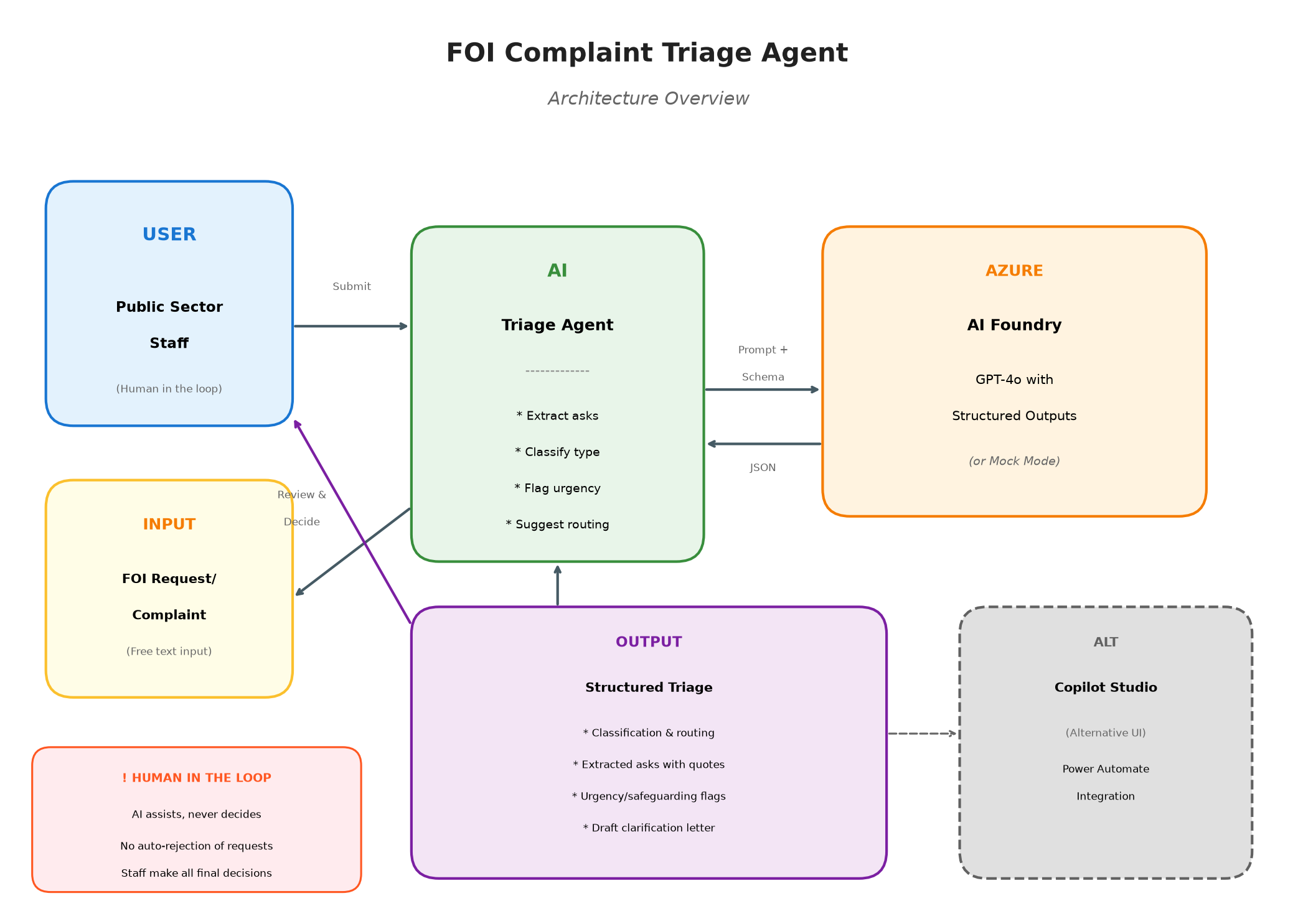
The same steps are listed here and drawn below. Step 5 is the human approval. Anything after that is done by staff in the systems they already use. The standard harness and the GitHub Copilot harness both stop at that step. Neither one adds an approval point.
- A member of staff pastes one submission.
- The agent reads that text, and its own instructions. It does not look up the requester.
- Microsoft Foundry returns structured JSON, or mock mode does if no credentials are set.
- The draft shows the type, the asks with quotes, flags, a routing suggestion, a cost note, and a clarification letter if one was drafted.
- Human approval. An FOI or complaints officer accepts or corrects the classification, the routing, any safeguarding escalation, the cost-limit view, and the letter before it is sent.
- Staff record the case and send any letter through their normal route. The agent has no connector for that.
flowchart TD
    A["1. Staff paste one submission"] --> B["2. Agent reads that text only"]
    B --> C["3. Microsoft Foundry, or mock mode"]
    C --> D["4. Draft triage is shown"]
    D --> E["5. Human approval by an FOI or complaints officer"]
    E --> F["6. Staff record the case and send any letter themselves"]

    style E fill:#fff3cd,stroke:#997404
Architecture diagram
The diagram below is the file shipped in the experiment, copied into this site at build time.
Microsoft stack
| Piece | Role in this experiment |
|---|---|
| Python | The triage agent you can run from the folder. |
| Microsoft Foundry | Optional language-model call. The README uses a GPT-4o deployment name. No Foundry resource is created by the repository. |
| Mock mode | Rule-based Python, so the pipeline can be tried with no credentials. |
| JSON Schema | Checks the shape of the output. |
| Copilot Studio, standard harness | Lead intake. Topics and one Power Automate flow call the existing triage core and show the JSON. Not an importable solution. The steps are the ones already in copilot-studio/. |
| Copilot Studio, GitHub Copilot harness | Staff follow-up on the same JSON, with two skills. This harness is a Copilot Studio authoring and orchestration runtime. It is not the GitHub Copilot service. The same core and the same approval points. Billing is in Copilot Credits. Prices were not copied. |
| Microsoft Entra ID, Conditional Access, Key Vault, Purview, Application Insights, prompt shields | Named in the security guide as the controls for a deployment. This repository does not turn them on. |
The two harnesses
The harness comparison is the longer note. Short version, from Microsoft Learn pages opened on 24 October 2026:
The standard harness follows topics you define. It is the lead path because the intake is the same every time: paste one submission, run the triage, show the JSON, stop. The existing build guide is that harness.
The GitHub Copilot harness is a Copilot Studio runtime for multi-step work. It is not the GitHub Copilot service. Microsoft says customer data is not sent to the GitHub Copilot service when the agent runs in Copilot Studio, and that the harness can use skills, memory, and files, in a sandbox. It is billed in Copilot Credits from the moment you start building, including testing. A Microsoft 365 Copilot licence does not cover that usage, on the costs page opened the same day. This experiment's skills tell the agent to call src/triage_agent.py and to stop. They do not tell it to reject a request or send a letter.
The costs page says the standard harness is covered by a Microsoft 365 Copilot licence in Microsoft 365 channels, and billed otherwise. The article on standard-harness licensing was not opened, so this is not a licence opinion. Credit ranges on Microsoft's diagram were not copied.
The harness overview says skills and memory are "Not a focus" for the standard harness. A second Microsoft table, on the agents overview, says they are "Not supported" there and "Supported" on the GitHub Copilot harness. Those two cells are not reconciled here. Do not upload the skills onto the standard-harness agent. An agent cannot be transferred from one harness to the other.
Describing an agent in natural language, agent instructions, Memory, and triggers are marked preview on the agents page. The skills upload page links to "Create an agent (preview)". That article was not opened. The harness overview itself did not label the harness as preview. Whether memory can be switched off was not on the pages opened. The skills say not to store the submission anyway.
The Customer Conversation harness is not used. A requester chatting with this agent would be a different product.
Security and permissions
Manifest exp-01-foi-triage, version 1.0.0. Owner in the manifest: Information Rights Team. Autonomy A1, human approves everything. auto_actions_enabled is false. Writes are disabled. Sends are disabled. All five high-risk actions (approve or reject, regulated decision, production record change, external send, spend) are disabled.
The contact address in the manifest, foi-triage-support@example.gov.uk, is a placeholder. So are the kill-switch contacts on example.gov.uk.
What a run may read. The submission a member of staff pastes, and the static instructions. The text may contain names, contact details, and special-category data. The agent does not store it. Retention of whatever staff then file is the organisation's case schedule, which this repository does not set.
What it must not read. Case systems, HR, finance, email, requester identity databases, and previous requests by the same person. The manifest says each request is assessed on its own content, not by profiling the requester.
Human approval, all mandatory.
| Before anyone relies on it | Who |
|---|---|
| Accept the classification | FOI or complaints officer |
| Act on the routing suggestion | FOI or complaints officer |
| Escalate a safeguarding flag | FOI or complaints officer, or the safeguarding lead |
| Send the clarification letter | FOI or complaints officer |
| Apply the cost-limit assessment | FOI or complaints officer |
Viewing the draft, or running it again, has no external effect and does not need a separate approval.
UK GDPR, as written in the manifest. Lead basis Article 6(1)(e), public task, with Article 6(1)(c), legal obligation, as the secondary basis, because responding to FOI, EIR, and SAR requests is a statutory duty. Special-category data may appear. The manifest cites Article 9(2)(g), substantial public interest, and Data Protection Act 2018 Schedule 1, Part 2, paragraph 6. Safeguards named there: classification only, no decision on that data, human review, and no persistence beyond the session. Production inference is assumed to run in UK South or UK West. That assumption is for the deploying organisation to confirm. This page is not a DPIA.
Prompt injection. The manifest lists prompt hardening, structured output, Microsoft Foundry prompt shields, human review, and the absence of any external action. The residual risk it records is a misleading classification, contained because a person reviews every output and the agent cannot act.
Risk register, assessed 24 October 2026. Likelihood × impact. Residual risk in the manifest is Low for each row after the controls. Inherent risk is not all Low.
| ID | Risk | Inherent | Residual | Owner in the manifest |
|---|---|---|---|---|
| R1 | Wrong classification delays the response | Medium | Low | FOI team lead |
| R2 | A safeguarding concern is missed | High | Low | Safeguarding lead |
| R3 | Prompt injection produces a misleading draft | Medium | Low | Information security |
| R4 | Bias in classification or routing | Medium | Low | FOI team lead |
| R5 | Data breach through the model service | Medium | Low | Information security |
| R6 | The service is unavailable | Low | Low | IT operations |
| R7 | Someone sees a triage output who should not | Medium | Low | Information security |
Logging. The manifest says to log the invocation, the user, the size of the input rather than the text, the triage id, flags, and errors. It assumes Application Insights and the organisation's SIEM. Those are deployment choices.
Kill switch. Turn the Copilot Studio agent off, revoke the key in Key Vault, block access with Conditional Access, or block the connector with a Power Platform DLP policy. Who can do each of those is in the manifest.
Review. Last reviewed 24 October 2026. Next review 24 April 2027. Reviewer named as the Information Governance Board, which the manifest marks as an assumption.
ATRS. The manifest maps agent name, description, scope, human oversight, risk, and the UK GDPR section to ATRS fields. The experiment says a public-facing deployment would likely need a record. This starter is written for staff, not for the public to use directly. The organisation submits any record. This repository does not.
The full note for governance readers is docs/security-and-permissions.md.
How to try it
Python 3.10 or newer. No credentials are required for mock mode. No key is stored in the repository.
cd experiments/01-foi-complaint-triage
python -m pip install -r requirements.txt
python src/triage_agent.py --mock --input examples/sample_request.txt
A Foundry run is the same command without --mock. It expects AZURE_OPENAI_ENDPOINT, AZURE_OPENAI_API_KEY, and AZURE_OPENAI_DEPLOYMENT. You supply those in your own environment.
The synthetic set has 12 cases. The experiment README records a mock-mode pipeline smoke test of 12 of 12 cases processed. Mock mode was tuned to that set. The README says this shows that the pipeline runs and says nothing about model accuracy. Real-model evaluation is marked pending.
Unit tests:
python -m pytest tests/ -v
Either harness is rebuilt by hand. The standard harness is copilot-studio/README.md. The GitHub Copilot harness is docs/github-copilot-harness.md, with skills under skills/. There is nothing to import. Use the synthetic fixtures. Do not paste a live request into a shared test environment. Building the GitHub Copilot harness in a tenant consumes Copilot Credits. This page does not quote a price.
Limitations
- Mock mode is keyword matching. It will not behave like a model.
- The agent does not learn from staff decisions. That is deliberate.
- Classification assumes the UK FOI, EIR, and data-protection framework.
- It is not a legal tool and does not advise on exemptions.
- Several deployment choices are marked as assumptions in the manifest, including UK region, retention, a one-hour safeguarding review, Application Insights, the escalation contacts, and the reviewing board.
- The security guide lists Dynamic Permissions, Dynamic Agent Risk, and Dynamic Conditional Access as announced, with availability unverified. Do not rely on them until that is confirmed.
- "What I learned" in the experiment README is still empty, waiting on a real-model test.
- Copilot Credit prices, and which licence includes which harness, were not copied beyond the sentences on the pages opened on 24 October 2026. The full standard-harness licensing article was not opened. Building the GitHub Copilot harness consumes credits from the start of building. This page does not quote a price.